Sky's the Limit: How America's Urban Air Rights Market Is Quietly Minting a New Generation of Real Estate Fortunes
Sky's the Limit: How America's Urban Air Rights Market Is Quietly Minting a New Generation of Real Estate Fortunes
For most of American history, real estate has been understood as a fundamentally horizontal endeavor — a matter of lots, parcels, and the ground beneath one's feet. Yet in the densest, most economically pressured cities across the country, a quiet revolution is unfolding several hundred feet above street level. The commodity at its center is not steel, glass, or concrete. It is, quite literally, nothing: the legally defined, financially transferable, and increasingly coveted space above existing structures.
Air rights — and the transferable development rights (TDRs) that govern their transaction — are no longer merely a technical footnote in municipal zoning codes. They have emerged as one of the more consequential and underappreciated frontiers in contemporary American real estate, attracting institutional capital, spurring architectural innovation, and forcing a fundamental reconsideration of how cities grow.
What Air Rights Actually Are — and Why They Matter Now
Under American property law, landowners historically possess rights not only to the surface of their parcels but to the column of space extending above them — subject, of course, to aviation regulations and municipal zoning restrictions. When a building does not utilize its full allowable height or density under local zoning ordinances, the unused capacity does not simply evaporate. It can, in many jurisdictions, be packaged and sold.
These transferable development rights allow a property owner — whether a private individual, a religious institution, a transit authority, or a municipality — to sell their unused vertical capacity to a developer seeking to build taller or denser elsewhere in a designated transfer zone. The seller monetizes space they were never going to occupy. The buyer acquires the legal permission to exceed what their own parcel's base zoning would otherwise permit.
The mechanism is not new. New York City formalized TDR frameworks decades ago, and landmark preservation efforts have long relied on air rights transfers to compensate owners of protected buildings that cannot be redeveloped. What has changed is the scale, the sophistication, and the urgency driving these transactions.
New York, Chicago, and Los Angeles: Three Cities, Three Approaches
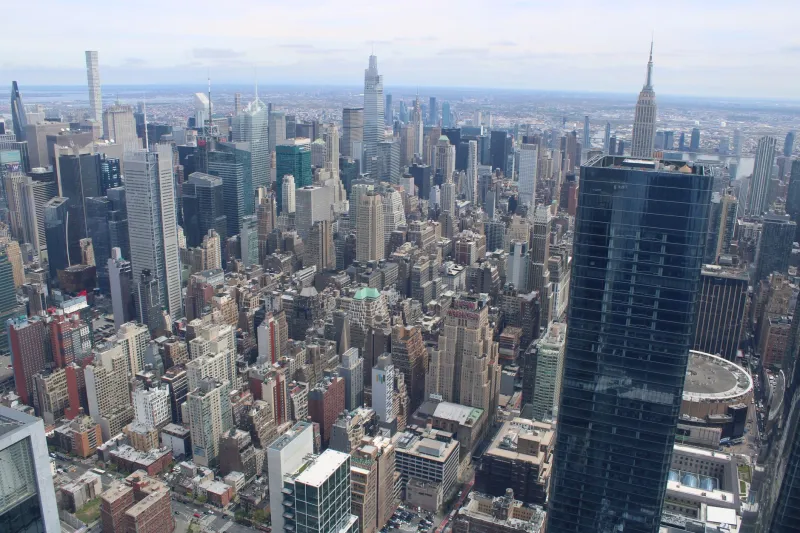
New York City remains the undisputed epicenter of air rights commerce in the United States. The market there operates with a complexity and dollar volume that rivals conventional property sales. Transactions in Manhattan have regularly exceeded $400 per square foot for air rights alone — figures that would have seemed implausible a generation ago. The supertall residential towers that now define the Midtown skyline, structures such as 432 Park Avenue and 111 West 57th Street, were made possible in substantial part through the strategic aggregation of air rights purchased from neighboring low-rise properties and institutional landowners.
Chicago has pursued a different model, one more directly intertwined with public infrastructure. The city's long-standing tradition of building above transit corridors — most visibly along its elevated rail network — has created a template for what urban planners increasingly call "air rights development over public assets." When the city explored redevelopment frameworks for underutilized rail yards and transit rights-of-way, the conversation inevitably turned to who owned the vertical space above those corridors and what that space was worth.
Los Angeles, historically resistant to the kind of density that defines its East Coast counterparts, is undergoing a recalibration. Zoning reforms driven by a severe housing shortage have expanded the geographic zones within which TDRs can be transferred, and transit-oriented development incentives have made the airspace above Metro stations a subject of genuine investor interest. The city's evolving posture on density is transforming air rights from an abstract legal concept into a practical tool for addressing one of the nation's most acute housing crises.
The Legal Architecture of an Invisible Asset
Investing in air rights demands a tolerance for legal complexity that exceeds most conventional real estate transactions. The regulatory frameworks governing TDRs vary dramatically not just from state to state, but from municipality to municipality — and in some cases, from zoning district to zoning district within a single city.
A successful air rights acquisition typically requires meticulous title research to confirm that the rights being sold have not already been transferred, encumbered, or extinguished by prior transactions or regulatory action. It requires careful analysis of the receiving site's zoning to confirm that the additional development capacity can be lawfully absorbed. And it demands coordination with municipal planning authorities, whose approval processes can be lengthy, politically sensitive, and subject to community opposition.
None of this has deterred sophisticated capital. Institutional investors, family offices, and a growing number of specialized real estate funds have begun treating air rights as a distinct line item in their urban portfolios — an asset whose value appreciates in direct proportion to the scarcity of ground-level development opportunity. In a city where a buildable surface parcel in a prime location may be functionally unobtainable, the vertical expansion enabled by a well-positioned TDR acquisition can represent the only viable path to new development.
Architectural Innovation as a Byproduct of Vertical Scarcity
The air rights market is not merely a financial phenomenon. It is also an architectural one. The structural and engineering challenges inherent in building above existing occupied structures, transit infrastructure, or historic landmarks have catalyzed genuine innovation in construction methodology.
Developing above a functioning rail corridor, for instance, requires platform structures capable of isolating vibration, managing load distribution, and accommodating the operational requirements of the infrastructure below. These constraints have driven advances in modular construction, deep foundation engineering, and building systems design that are now influencing projects well beyond the air rights context.
Furthermore, the aesthetic and programmatic demands of vertical development in constrained urban environments have pushed architects toward solutions — cantilevered structures, slender towers, mixed-use podiums — that are reshaping the visual character of American cities in ways that will be legible for generations.
What This Signals for the Future of Urban Density
The maturation of the air rights market carries implications that extend well beyond individual transactions or skyline aesthetics. It represents a fundamental acknowledgment that horizontal urban expansion — the model that defined American city-building throughout the twentieth century — has reached its practical and economic limits in many of the nation's most productive metropolitan areas.
As ground-level land costs continue their ascent and as municipalities face intensifying pressure to accommodate population growth without expanding their physical footprints, the vertical dimension of the city will become an ever more important planning and investment frontier. Air rights, once a technical curiosity, are becoming a strategic resource.
For investors, the lesson is one that The Real Estate Evolution has consistently emphasized: value in the built environment does not always announce itself at street level. Sometimes it hovers silently overhead, waiting for the right legal framework, the right market conditions, and the right vision to bring it down to earth.
The cities that learn to manage, price, and deploy that invisible inventory wisely will gain a meaningful advantage in the competition for density, economic vitality, and architectural distinction. The ones that do not may find themselves constrained not by a lack of land, but by a failure of imagination about what land, in the twenty-first century American city, actually means.