Asphalt to Assets: Why America's Oversupplied Parking Infrastructure Is Quietly Becoming Urban Real Estate's Most Compelling Frontier
Asphalt to Assets: Why America's Oversupplied Parking Infrastructure Is Quietly Becoming Urban Real Estate's Most Compelling Frontier
For decades, the parking lot occupied a peculiar position in the American urban imagination — simultaneously essential and invisible, a utilitarian afterthought stitched between buildings and swallowed by zoning codes. Yet today, that sea of cracked asphalt is attracting a different kind of attention. Investors, municipal planners, and housing advocates are converging on a shared realization: the United States is sitting on one of the most extraordinary underdeveloped land reserves in its history, and it happens to be located in the heart of its cities.
With roughly 800 million parking spaces spread across the country — approximately three for every registered vehicle — the arithmetic of surplus has become impossible to ignore. That figure, widely cited by urban researchers and transportation economists, represents not just a planning miscalculation of historic proportions, but an opportunity of equally historic scale.
How Parking Became America's Most Expensive Mistake
The origins of this glut trace back to the mid-twentieth century, when minimum parking requirements became a standard fixture of municipal zoning codes. Driven by assumptions rooted in peak automobile dependency, cities mandated that developers provide a prescribed number of spaces for virtually every land use — office buildings, shopping centers, apartment complexes, and restaurants alike. The result was a self-reinforcing cycle: more parking encouraged more driving, which justified more parking.
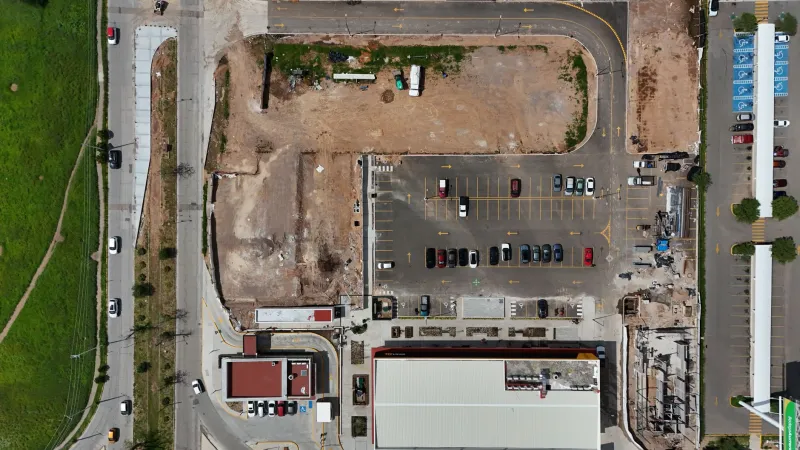
Urban economist Donald Shoup famously characterized these mandates as a hidden tax on urban density, arguing that the true cost of free parking was anything but free. Land that might otherwise have supported housing, commerce, or public green space was instead paved over and left largely idle for the majority of any given day. In many American downtowns, surface parking lots account for between 15 and 30 percent of total land area — a statistic that reads less like urban planning and more like urban surrender.
The Forces Accelerating Obsolescence
Three converging trends are now systematically undermining the economic rationale for maintaining this vast infrastructure.
Ride-hailing platforms — Uber and Lyft chief among them — have measurably reduced private vehicle ownership in dense urban cores, particularly among younger residents who increasingly view car ownership as a financial liability rather than a cultural milestone. Meanwhile, the normalization of hybrid and remote work arrangements following the pandemic has depressed weekday commuter parking demand in central business districts across the country, leaving downtown garages operating at fractions of their former capacity.
Perhaps most consequentially over the long term, the accelerating adoption of electric vehicles is beginning to reshape the physical logic of parking itself. As home charging becomes standard and autonomous vehicle technology matures, the very premise of destination parking — the assumption that a driver must leave a car stationary for hours while conducting daily business — faces structural disruption. Several transportation analysts project that fully autonomous ride-sharing fleets, once commercially viable, could eliminate the need for the majority of urban parking spaces within a generation.
Cities Already in Motion
The transformation is not theoretical. Across the country, municipalities and private developers are already converting underperforming parking assets into higher-value uses, offering early proof of concept for what may become one of the decade's most consequential real estate stories.
In Los Angeles — a city so historically synonymous with car culture that its parking minimums once defined the national standard — the city council voted in 2022 to eliminate minimum parking requirements near transit corridors. Developers responded swiftly, with dozens of infill housing projects breaking ground on former surface lots within transit-rich neighborhoods like Koreatown and Hollywood. The city's chronic housing shortage has given these conversions particular urgency, with affordable unit mandates frequently attached to entitlement approvals.
Houston, a city that built its identity on automotive accessibility, has witnessed a parallel shift in its urban core. The redevelopment of Midtown Houston has steadily absorbed surface parking lots that once fragmented the neighborhood's street grid, replacing them with mixed-income residential buildings, ground-floor retail, and pocket parks. The Houston Midtown Management District has actively facilitated these transitions, recognizing that walkable density generates more sustainable tax revenue per acre than asphalt ever could.
Minneapolis offers perhaps the most instructive model for colder-climate cities grappling with the same calculus. Following the elimination of citywide parking minimums in 2021, developers began converting underutilized ramp structures and surface lots in neighborhoods like North Loop and the Warehouse District into mixed-use projects that blend market-rate and affordable housing with ground-floor commercial activation. The city's commitment to transit investment has provided the demand foundation that makes reduced parking supply economically viable.
The Investment Calculus
For real estate investors, the parking-to-development pipeline presents a nuanced opportunity. Surface lots, by virtue of their minimal improvements, typically carry lower acquisition costs per square foot than developed properties — a structural advantage that can meaningfully compress total project costs when entitlement and construction timelines are managed effectively.
However, the conversion thesis is not without its complications. Structured parking garages present a considerably more complex redevelopment challenge than surface lots, given their floor-to-floor heights, ramp configurations, and load-bearing specifications that often conflict with residential or office conversion requirements. Several adaptive reuse projects have demonstrated creative solutions — transforming garage levels into live-work studios or vertical farming operations — but these remain exceptions rather than a scalable model.
Zoning reform is the critical enabling variable. In markets where minimum parking requirements remain intact, the economic incentive to convert parking assets is substantially diminished, since any replacement development may simply be required to rebuild equivalent parking supply. Cities that have moved aggressively to eliminate or substantially reduce these mandates — including Buffalo, Hartford, and San Jose in addition to those already mentioned — have created the regulatory conditions under which market forces can drive conversion at meaningful scale.
Green Space as a Competing Highest Use
Not every parking lot conversion will — or should — produce density. In neighborhoods with existing housing oversupply or where market-rate development economics are unfavorable, the conversion of surface parking into community green space, urban agriculture, or stormwater management infrastructure may represent the most socially and environmentally productive outcome.
Several mid-sized American cities, including Dayton, Ohio, and Gary, Indiana, have begun piloting programs that transform abandoned surface lots into managed green corridors, reducing urban heat island effects while providing neighborhood amenity. These interventions, while generating no direct tax revenue, contribute measurable quality-of-life improvements that stabilize surrounding residential property values — an indirect but genuine return on public investment.
What Comes Next
The pace at which America's parking surplus is converted into productive real estate will depend on the alignment of several variables: the continued liberalization of parking-related zoning codes, the trajectory of autonomous vehicle technology, the political will to prioritize housing production on publicly owned parking assets, and the appetite of institutional capital for what remains a relatively nascent asset conversion thesis.
What is increasingly clear, however, is that the era of the parking lot as a passive placeholder — a land use by default rather than by design — is drawing to a close. The same forces that rendered the drive-in theater and the regional mall economically obsolete are now turning their attention to the humble parking lot, and the real estate industry is beginning to pay serious attention.
For investors willing to engage with the complexity of entitlement, adaptive design, and community stakeholder engagement, the asphalt frontier may prove to be one of the most rewarding chapters in American urban development. The land has always been there. The moment to act on it is arriving.