Small Towns, Big Returns: How Remote Work Is Permanently Redrawing America's Real Estate Map
Small Towns, Big Returns: How Remote Work Is Permanently Redrawing America's Real Estate Map
For most of the twentieth century, the formula for American real estate value was straightforward: proximity to economic centers determined price. Manhattan commanded premiums. Detroit suburbs tracked the fortunes of the auto industry. Rural towns, by and large, remained affordable precisely because they sat far from the engines of commerce. Then, in the spring of 2020, that formula was quietly dismantled.
The mass adoption of remote work — initially a crisis response — evolved into a permanent reconfiguration of where Americans choose to live. And in its wake, a new category of boomtown has emerged: the so-called "Zoom Town," a smaller city or rural community that has experienced explosive real estate demand driven not by local industry, but by the geographic liberation of knowledge workers.
Anatomy of a Zoom Town
Not every small American city qualifies. The communities that have attracted the most significant inflows share a recognizable profile: natural amenities such as mountains, rivers, or coastline; a pre-existing cultural infrastructure of restaurants, breweries, and arts venues that signals livability; broadband connectivity sufficient to support remote professionals; and, critically, a starting price point that made early movers feel they were getting genuine value relative to their origin city.
Bozeman, Montana, is perhaps the most cited example. Between 2019 and 2023, median home prices in Gallatin County — which encompasses Bozeman — rose by more than 70 percent, according to data from the Montana Association of Realtors. The city, long known as a college town adjacent to world-class skiing and fly-fishing, found itself absorbing transplants from Seattle, San Francisco, and Denver at a pace its housing infrastructure was entirely unprepared to accommodate.
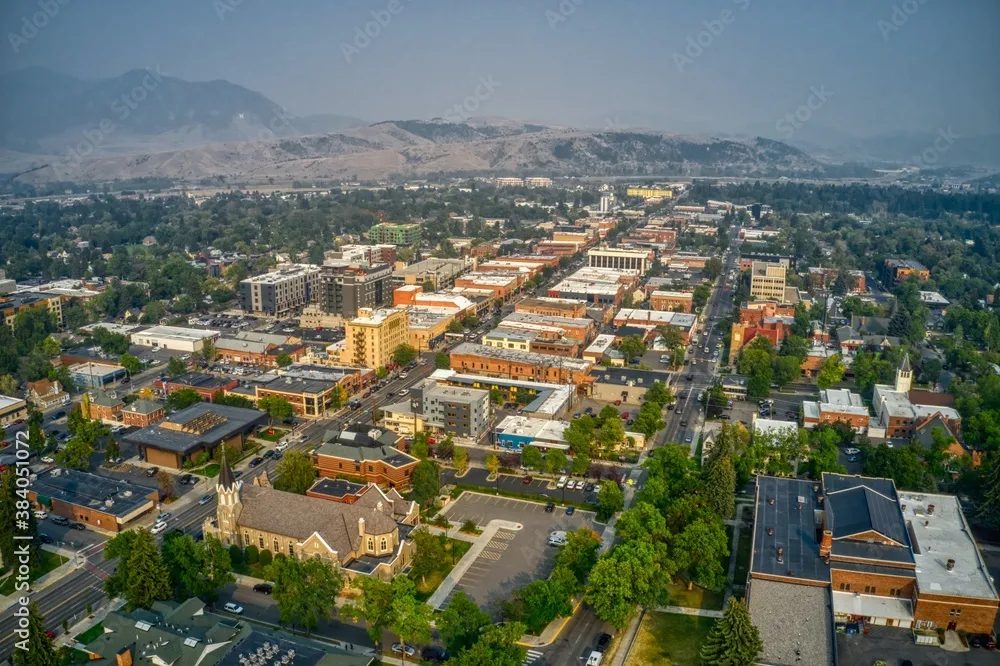 Photo: Bozeman, Montana, via as1.ftcdn.net
Bend, Oregon, tells a similar story. Situated at the eastern edge of the Cascades, Bend had already been growing steadily throughout the 2010s, but the remote work surge accelerated its trajectory dramatically. The city's outdoor recreation economy — skiing at Mt. Bachelor, mountain biking on the Deschutes National Forest trail system, whitewater kayaking — became a professional amenity rather than merely a weekend pursuit. Remote workers could now live the lifestyle full-time while drawing salaries calibrated to San Jose or Portland.
 Photo: Bend, Oregon, via www.ilmiocaneleggenda.it
Other communities that have registered meaningful Zoom Town dynamics include Flagstaff, Arizona; Asheville, North Carolina; Steamboat Springs, Colorado; and even smaller markets such as Whitefish, Montana, and Taos, New Mexico.
The Economic Mechanics of the Migration
The financial logic driving this migration is not difficult to parse. A software engineer earning $180,000 annually in San Francisco, where a modest two-bedroom condominium might list at $1.2 million, can purchase a four-bedroom home with mountain views in Bozeman for $650,000 — and retain the same salary. The arbitrage is compelling, and it has produced something genuinely novel: a class of high-income earners whose purchasing power is entirely decoupled from the local wage economy.
This dynamic has profound implications for incumbent residents. Local teachers, healthcare workers, tradespeople, and service industry employees — whose incomes are anchored to regional wage scales — have found themselves competing in property markets inflated by out-of-market purchasing power. In Gallatin County, workforce housing shortages have become a municipal crisis, with essential service workers commuting from communities an hour or more away because they can no longer afford to live where they work.
Local governments have responded with varying degrees of urgency. Some communities have pursued inclusionary zoning requirements, mandating affordable unit set-asides in new residential developments. Others have explored community land trusts as a mechanism for preserving long-term housing affordability. The effectiveness of these interventions, in markets experiencing demand pressure of this magnitude, remains an open question.
Structural Shift or Speculative Cycle?
The more consequential debate in real estate circles concerns the permanence of this trend. Optimists — and most institutional investors with capital deployed in secondary and tertiary markets — argue that the remote work transformation represents a durable structural change. They point to the sustained adoption of hybrid and fully remote arrangements by major employers, the generational preference of younger workers for lifestyle-driven location choices, and the irreversibility of infrastructure investments that have improved broadband access in previously underserved communities.
Skeptics, however, raise legitimate counterpoints. Return-to-office mandates from major technology and financial firms have already pulled some remote workers back toward urban centers. Mortgage rate increases since 2022 have cooled transaction volumes in Zoom Towns considerably, with some markets registering meaningful price corrections from their 2021 and 2022 peaks. Bend, for instance, saw median prices decline approximately 12 percent from peak levels by mid-2023, though they remained substantially above pre-pandemic baselines.
The more nuanced interpretation — and likely the more accurate one — is that the remote work migration has permanently expanded the addressable market for small-town American real estate without eliminating the cyclical forces that govern all property markets. The floor has been raised. Whether any particular market has overshot that new floor is a property-specific and timing-specific judgment.
What This Means for Real Estate's Future
For investors and practitioners operating at the frontier of American real estate, the Zoom Town phenomenon offers several durable lessons. Geographic diversification of real estate portfolios — long a theoretical virtue — has become a practical imperative. Secondary and tertiary markets that were once considered illiquid or too small for institutional attention are now generating transaction volumes and price appreciation that demand serious analysis.
For individual buyers, the calculus is more personal. Purchasing in a Zoom Town at current prices requires confidence both in the buyer's own employment stability and in the long-term desirability of the specific community. Markets with genuine natural amenity scarcity — there is, after all, only one Yellowstone gateway — are likely to retain value more reliably than those whose appeal rests primarily on relative affordability.
What the Zoom Town era has demonstrated, above all, is that real estate value is not fixed geography. It is a function of where people want to live, and technology has fundamentally expanded the range of answers to that question. That expansion, regardless of the cyclical noise layered on top of it, appears permanent.