Renting the American Dream: How Build-to-Rent Communities Are Challenging a Century of Homeownership Culture
The white picket fence. The thirty-year mortgage. The deed filed at the county courthouse. For the better part of a century, homeownership has functioned in the American cultural imagination as more than a financial transaction — it has been a rite of passage, a marker of stability, and the primary mechanism by which middle-class families accumulate intergenerational wealth. That narrative is now encountering a formidable structural challenger.
Build-to-rent — the practice of constructing entire single-family residential communities designed from inception for long-term rental occupancy — has evolved from a post-2008 institutional experiment into one of the fastest-growing segments of the American housing market. In 2023, build-to-rent construction starts accounted for approximately 8 percent of all new single-family housing activity in the United States, according to data from the National Association of Home Builders. That figure was negligible a decade ago.
The Architecture of a New Asset Class
Understanding what distinguishes build-to-rent from conventional rental housing requires moving beyond the surface-level observation that these are houses occupied by tenants. Purpose-built single-family rental communities are developed with a fundamentally different operational logic than traditional for-sale subdivisions.
In a build-to-rent development, the developer — often backed by institutional capital from real estate investment trusts, private equity funds, or large asset managers — retains ownership of every unit at the community level. Properties are designed for durability and operational efficiency: standardized floor plans that reduce maintenance complexity, smart home technology integrated from the ground up, and community amenities — pools, fitness centers, dog parks, co-working spaces — that are managed centrally rather than administered by a homeowners association of individual owners.
Major operators in this space include Invitation Homes, American Residential Properties, and a growing roster of developers such as NexMetro Communities and Christopher Todd Communities, both of which have concentrated significant activity in the Phoenix metropolitan area. Atlanta, Dallas-Fort Worth, Charlotte, and Jacksonville have also emerged as primary build-to-rent markets, attracted by land availability, population growth, and regulatory environments favorable to large-scale residential development.
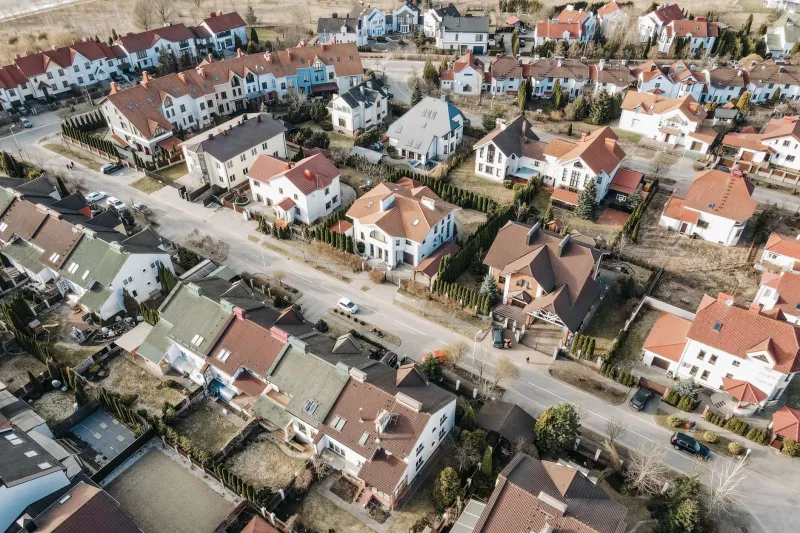
 Photo: Dallas-Fort Worth, via c8.alamy.com
The resident experience in these communities is, by design, meaningfully different from what most Americans associate with apartment living. Tenants occupy standalone or attached single-family homes with private yards, driveways, and garages. Lease terms are typically twelve months or longer, with professional property management handling maintenance requests, landscaping, and community operations. The pitch to prospective residents is explicit: the lifestyle of homeownership, without the financial exposure.
The Wealth-Building Question
It is precisely that final phrase — without the financial exposure — that generates the most substantive debate about what build-to-rent means for American society.
For decades, homeownership has been the primary vehicle through which middle-income American families build wealth. The Federal Reserve's Survey of Consumer Finances consistently documents a substantial net worth gap between homeowners and renters, with the median homeowner household holding net worth approximately forty times greater than that of the median renter household. Much of that disparity is attributable to home equity accumulation — the forced savings mechanism embedded in a principal-amortizing mortgage.
Critics of the build-to-rent model argue that it accelerates a troubling trend: the transfer of residential real estate from individual owner-occupants to institutional balance sheets, effectively converting what was once an asset-building opportunity for families into a perpetual income stream for investors. If the supply of for-sale single-family housing is constrained — partly because build-to-rent developers are competing for the same land and construction capacity — then homeownership rates may decline not by choice but by necessity, disproportionately affecting younger and lower-income households.
There is empirical basis for this concern. The U.S. homeownership rate, which peaked at approximately 69 percent in 2004, has trended between 64 and 66 percent through most of the post-2008 period. Affordability constraints driven by rising home prices and elevated mortgage rates have extended the timeline to first purchase for many Millennial and Gen Z households, making the professionally managed rental alternative increasingly attractive — or simply the only viable option.
The Case for Reconsidering the Ownership Imperative
And yet, a rigorous analysis of the build-to-rent phenomenon resists simple condemnation. There is a credible affirmative case to be made for the model, one that challenges some of the more romanticized assumptions embedded in homeownership advocacy.
Owning a home carries substantial financial risks that are routinely underweighted in popular discourse. Maintenance costs — commonly estimated at one to two percent of a home's value annually — represent a significant and unpredictable expense burden. Transaction costs for buying and selling, including agent commissions, title insurance, and closing fees, can consume six to ten percent of a home's value, making homeownership financially suboptimal for households that relocate within five to seven years. And concentrated exposure to a single illiquid asset in a single geographic market is, from a portfolio theory perspective, a peculiar form of financial risk management.
For households whose life circumstances favor mobility — early-career professionals, families navigating school district decisions, individuals in industries with geographic volatility — a professionally managed single-family rental in a well-amenitized community may represent a genuinely superior arrangement. The optionality has real value. The absence of a major repair bill following a water heater failure or a roof replacement has real value. The ability to relocate without navigating a sale transaction has real value.
The question is whether the market will price these benefits fairly, or whether institutional landlords will extract rents that eliminate the financial case for tenants.
Innovation at the Intersection of Tenure and Technology
One dimension of the build-to-rent sector that aligns particularly closely with the broader trajectory of real estate innovation is its embrace of property technology. Purpose-built communities have a significant advantage over legacy rental housing stock in their capacity to integrate smart home systems, app-based maintenance management, keyless access, energy monitoring, and community communication platforms from the ground up rather than as retrofits.
This operational sophistication matters for the resident experience, but it also matters for the investor thesis. Lower maintenance costs, higher tenant retention rates, and more granular data on asset performance make build-to-rent communities more attractive to institutional capital — which in turn accelerates the sector's growth and shapes the competitive landscape that individual homeowners and traditional landlords must navigate.
A Recalibration, Not an Abolition
The honest assessment of build-to-rent's long-term significance is that it represents a recalibration of the American housing system rather than the abolition of the ownership ideal. Homeownership will remain a viable and wealth-generative path for millions of American households. But the cultural assumption that ownership is inherently superior to renting — regardless of individual financial circumstances, life stage, or market conditions — is a simplification that the evolution of this sector invites Americans to reexamine.
The real estate market of the next decade will likely accommodate both models with greater sophistication than the binary of owner versus renter has historically permitted. For practitioners, investors, and policymakers, understanding the build-to-rent sector not as a threat to be resisted but as a structural evolution to be shaped — through thoughtful regulation, inclusive design standards, and tenant protection frameworks — may prove the more productive orientation.
The American Dream is not a fixed asset. It has always been subject to revision.