Green Equity: How Energy-Efficient Home Upgrades Are Becoming America's Smartest Wealth-Building Strategy
Green Equity: How Energy-Efficient Home Upgrades Are Becoming America's Smartest Wealth-Building Strategy
For decades, the calculus of home improvement was relatively straightforward: renovate the kitchen, update the bathrooms, and watch your resale value climb. Yet a quieter revolution is underway in American housing—one measured not in granite countertops but in kilowatt-hours, BTUs, and utility bills that no longer arrive. Homeowners who have invested in energy-efficient retrofits are increasingly reporting something unexpected: the upgrades are paying for themselves, and in many cases, generating returns that traditional renovation projects simply cannot match.
This is not merely an environmental story. It is, at its core, a real estate story—one about evolving property values, shifting lender behavior, and a federal incentive structure that has never been more generous.
The Rising Cost of Doing Nothing
The financial case for energy efficiency begins with a number that most American homeowners know intimately: their monthly utility bill. The U.S. Energy Information Administration has tracked consistent upward pressure on residential electricity rates over the past decade, with average household energy expenditures now exceeding $2,000 annually in many regions. In high-cost states such as California, Massachusetts, and New York, that figure climbs considerably higher.
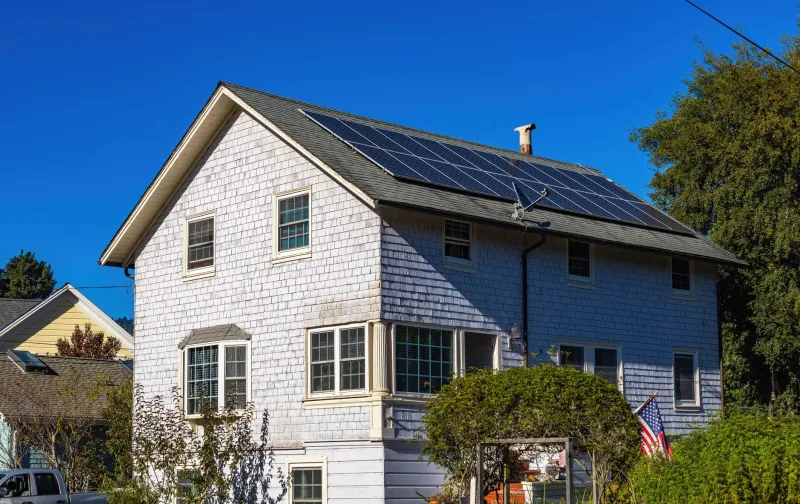
When a homeowner installs a properly sized solar array, upgrades to a modern heat pump system, or seals a leaky building envelope with spray foam insulation, those recurring costs do not simply shrink—they can, in many circumstances, approach zero. Some solar adopters with net metering agreements actually receive credits from their utilities, effectively running their meters in reverse.
The financial logic, viewed through this lens, becomes difficult to dismiss. A household spending $250 per month on energy that eliminates that expense is realizing the equivalent of a $3,000 annual raise—tax-free, and inflation-resistant by design.
Federal Incentives Have Changed the Equation
What has dramatically accelerated adoption is the Inflation Reduction Act of 2022, which introduced or extended a suite of tax credits that have made energy-efficient upgrades accessible to a far broader swath of American homeowners than previous programs ever reached.
The residential clean energy credit currently allows homeowners to claim 30 percent of the cost of qualifying solar installations, battery storage systems, and geothermal heat pumps directly against their federal tax liability—not merely as a deduction, but as a dollar-for-dollar credit. Separately, the energy-efficient home improvement credit covers up to $3,200 annually for qualifying upgrades including heat pumps, insulation, and energy-efficient windows and doors.
For a homeowner investing $25,000 in a rooftop solar installation, the 30 percent credit alone represents a $7,500 reduction in effective cost. When combined with state-level rebates—many of which have expanded in parallel with federal programs—the out-of-pocket investment can fall substantially further. In practical terms, the federal government is now subsidizing a meaningful portion of the transition to high-performance housing.
Appraisals Are Struggling to Keep Pace
Here is where the story becomes more complicated. Despite the demonstrable financial value that energy-efficient systems deliver, the residential appraisal industry has been slow to develop consistent methodologies for capturing that value in property assessments.
The traditional comparable-sales approach—in which an appraiser estimates a home's value by examining what similar nearby properties have recently sold for—works reasonably well in stable, homogeneous markets. It works far less well when the subject property produces its own electricity, requires minimal heating expenditure, and carries lower operating costs than virtually every comparable on the market.
The Appraisal Institute has developed tools such as the Green Addendum and the Residential Green and Energy Efficient Addendum to help practitioners document energy features more rigorously. Progress has been real but uneven. In markets where green building has achieved critical mass—Colorado's Front Range, the Pacific Northwest, and parts of the Mid-Atlantic corridor—appraisers have access to sufficient comparable data to price efficiency features with reasonable confidence. In markets where high-performance homes remain uncommon, the value often goes uncaptured entirely.
This appraisal gap has real consequences. A homeowner who invests $40,000 in solar, insulation, and HVAC upgrades may find that the formal appraisal of their property reflects little or none of that investment—creating a frustrating disconnect between actual financial performance and assessed market value.
Lenders Are Beginning to Take Notice
If appraisers have been cautious, certain segments of the lending industry have moved with somewhat greater urgency. Energy-efficient mortgages, a product category that has existed in limited form for years, are gaining renewed attention as both Fannie Mae and Freddie Mac have expanded their frameworks for accommodating energy performance in underwriting.
Fannie Mae's HomeStyle Energy mortgage, for instance, allows borrowers to finance the cost of energy-efficient improvements as part of a purchase or refinance transaction, incorporating projected utility savings into the debt-to-income calculations used to determine borrowing capacity. The underlying logic is sound: a borrower whose monthly energy costs drop by $200 following an upgrade has meaningfully more disposable income to service debt, even if their gross income has not changed.
Private lenders are also experimenting with green mortgage products that offer marginally lower interest rates or reduced fees to borrowers purchasing or improving high-performance properties. While these products remain a small fraction of overall origination volume, their presence signals that the financial industry is beginning to treat energy performance as a legitimate risk and value variable—not merely a marketing feature.
The Investor Calculus
For real estate investors, the efficiency equation carries additional dimensions. In the single-family rental market, where landlords bear utility costs in some lease structures and tenants bear them in others, the financial implications shift depending on how expenses are allocated. Net-lease arrangements, in which tenants pay utilities directly, may reduce a landlord's immediate incentive to invest in efficiency—though mounting tenant demand for lower-cost housing is beginning to change that calculus.
In multifamily properties, where owners typically pay common-area energy costs and often subsidize unit utilities, the return on efficiency investment is more direct. Building owners who have undertaken deep energy retrofits—replacing aging HVAC systems, upgrading lighting to LED, and improving building envelopes—frequently report operating expense reductions that translate directly into improved net operating income and, by extension, higher asset valuations.
Commercial real estate, particularly office and industrial properties, has been faster than the residential sector to formalize energy performance measurement, partly because institutional buyers demand it and partly because ENERGY STAR scores and LEED certifications have become recognized proxies for asset quality in that market.
A New Definition of Home Value
The broader implication of these converging trends is that the definition of residential property value is quietly expanding. For most of the twentieth century, home value was understood primarily in terms of location, size, condition, and aesthetic appeal. Energy performance was, at best, a footnote.
That framework is evolving. As utility costs continue their long-term upward trajectory, as climate volatility makes energy resilience a practical rather than theoretical concern, and as a generation of buyers who have grown up with environmental awareness enters the market as purchasers, the performance characteristics of a home's mechanical and thermal systems are becoming legitimate components of its market value.
The homeowners and investors who recognize this shift early—and who deploy capital accordingly—are positioning themselves to benefit from a repricing that, by most indications, is still in its early stages. Going green, in this context, is no longer simply an expression of values. It is increasingly an expression of financial foresight.