Mapping the Migration: How a Warming Climate Is Redrawing America's Real Estate Landscape in Real Time
Mapping the Migration: How a Warming Climate Is Redrawing America's Real Estate Landscape in Real Time
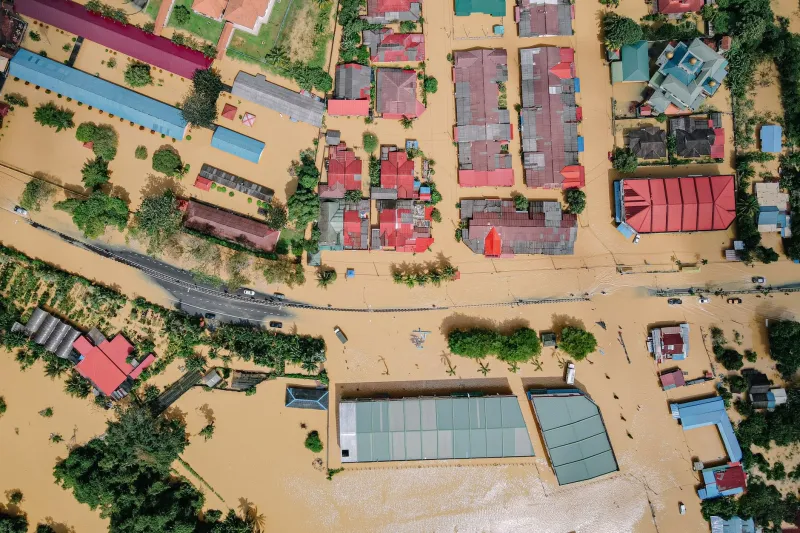
The calculus was not made overnight. For many American families, the decision to leave a home in coastal Florida, fire-prone Northern California, or the flood-prone Gulf Coast was the product of years of accumulating evidence — rising insurance premiums, repeated evacuation orders, a basement that flooded twice in a decade, a sky that turned orange from smoke that drifted a thousand miles. The decision, when it finally came, felt less like a choice and more like an acknowledgment of a reality that had been building for years.
This is the lived experience behind what researchers and demographers are increasingly calling climate migration — a phenomenon that, while not yet fully reflected in official population statistics, is reshaping American real estate markets in ways that are measurable, accelerating, and, for the well-positioned investor or buyer, full of implication.
The Data Underneath the Anecdote
The evidence that climate risk is influencing residential mobility patterns is no longer speculative. First Street Foundation, a nonprofit research organization specializing in climate risk modeling, has documented a clear and statistically significant relationship between flood risk exposure and population outflow in vulnerable coastal and riverine communities. Meanwhile, research from the Federal Reserve Bank of San Francisco has found that homes in high wildfire-risk zones are beginning to trade at measurable discounts relative to comparable properties in lower-risk areas — a phenomenon that did not appear with the same clarity in data from a decade ago.
Insurance markets are often the leading indicator. In states including Florida, California, and Louisiana, major carriers have either dramatically increased premiums or withdrawn from the market entirely, leaving homeowners reliant on state-backed insurers of last resort. When private capital departs a market, it is rarely without reason — and the signal that departure sends to prospective buyers and lenders is unambiguous.
Mortgage markets are beginning to internalize this signal as well. Federal regulators have raised questions about the extent to which climate-exposed properties on bank balance sheets represent unpriced systemic risk, and some lenders are quietly tightening underwriting standards for properties in designated high-risk zones. The secondary mortgage market, which ultimately determines the liquidity of most American home loans, is watching these developments with considerable attention.
The Rise of the Climate Haven
As high-risk regions grow less hospitable to long-term real estate investment, a parallel conversation has emerged around so-called climate havens — cities and regions that combine relative environmental stability with the economic and social infrastructure necessary to absorb significant population growth.
The cities most frequently cited in this context share several characteristics: they are located inland, away from hurricane-prone coastlines; they sit at elevations that reduce flood exposure; they have access to stable freshwater supplies; and their climates, while not immune to change, are projected to remain within habitable parameters under most warming scenarios.
Duluth, Minnesota, has emerged as perhaps the most discussed example. Situated on the western tip of Lake Superior, Duluth possesses an extraordinary freshwater resource, a relatively mild summer climate by regional standards, and a housing stock that remains affordable by national benchmarks. The city's leadership has actively leaned into the climate haven narrative, positioning Duluth as a destination for climate-conscious migrants in municipal planning documents and economic development strategies.
Buffalo, New York, presents a similar profile. Long associated with post-industrial decline, Buffalo has experienced a quiet but genuine residential revival, driven in part by its access to Great Lakes water, its relatively affordable real estate, and a growing recognition among buyers that its climate trajectory is more favorable than many Sun Belt alternatives. Property values in Buffalo have risen meaningfully over the past several years, though they remain well below coastal market levels — a spread that migration advocates argue will narrow considerably as climate awareness deepens.
Boise, Idaho, occupies a more complicated position in the climate haven conversation. Its rapid population growth over the past decade has already driven significant home price appreciation, and its long-term water security — dependent on snowpack that is itself vulnerable to warming — is a legitimate subject of debate among climate scientists. Nevertheless, Boise continues to attract households relocating from California's wildfire corridors, drawn by its combination of natural amenity, economic dynamism, and relative distance from the coastline.
Technology's Role in Pricing the Unpriced
One of the most consequential developments in this space is the rapid maturation of climate risk data platforms — a PropTech category that barely existed a decade ago and is now attracting significant venture capital and institutional interest.
Companies including First Street Foundation, Jupiter Intelligence, and ClimateCheck are building increasingly granular, property-level risk models that assess exposure to flooding, wildfire, extreme heat, drought, and wind across multi-decade time horizons. These tools are being integrated into real estate search platforms, lender underwriting systems, and institutional due diligence processes at a pace that is fundamentally changing how climate risk is disclosed and priced.
Zillow and Realtor.com have both introduced climate risk indicators directly into property listings, making this information accessible to mainstream homebuyers in a way that was previously available only to sophisticated institutional actors. The democratization of climate data is, in effect, accelerating the pricing-in of risk that markets had previously been slow to reflect.
For investors and developers, these platforms are enabling a new form of portfolio construction — one that explicitly weights climate trajectory alongside traditional metrics like cap rates, population growth, and employment diversity. The emergence of climate-adjusted underwriting represents one of the more significant methodological evolutions in real estate investment analysis in recent memory.
Regions at Risk and the Question of Equity
Any honest accounting of climate migration must grapple with a dimension that market analysis alone cannot fully capture: the profound inequity embedded in who can afford to move and who cannot.
The households most exposed to climate risk — in flood-prone rural Louisiana, in heat-stressed Phoenix neighborhoods without air conditioning, in wildfire-adjacent communities where insurance has become unaffordable — are disproportionately lower-income, disproportionately communities of color, and disproportionately without the financial resources to execute a voluntary relocation. For these households, climate migration is not a portfolio decision. It is a crisis.
Policymakers at the federal, state, and municipal levels are only beginning to grapple with the fiscal and social implications of managed retreat — the deliberate, planned relocation of communities away from high-risk zones. The political and logistical challenges are formidable, and no comprehensive national framework currently exists.
For the real estate industry, this dimension of the climate migration story is not merely a matter of social responsibility, though it is certainly that. It also represents a material risk: communities that lose population suddenly and involuntarily generate distressed property markets, municipal fiscal stress, and the kind of economic feedback loops that can depress regional real estate values across asset classes.
Positioning for a Warmer Future
The buyers and investors who will navigate this transition most successfully are likely those who treat climate risk not as a checkbox in a due diligence process but as a foundational input into long-term real estate strategy. That means stress-testing assumptions about insurance availability and cost, scrutinizing the climate trajectories of target markets over 20- and 30-year horizons rather than the typical five-year investment window, and paying close attention to the signals that insurance and mortgage markets are already sending.
It also means recognizing that the geography of American real estate value is not fixed. The cities and regions that will define the next chapter of American real estate growth may look very different from those that defined the last one — and the window to position ahead of that shift is, by most assessments, already narrowing.